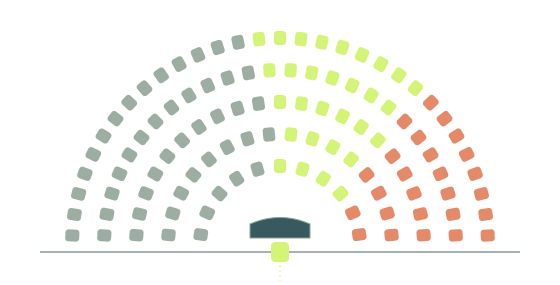
Live from Capitol Hill · 119th Congress in session

CONGRESS
isn't boring.
you just
never looked close.

535 people. $6.8 trillion budget. The power to declare war, tax your paycheck, and decide if your group chat memes are illegal. Let's decode the weirdest, messiest, most powerful club in America.

let's go → skip to quiz
// Chapter 01 — The Setup

Two rooms,
one vibe shift.

Congress is a bicameral legislature — fancy word for "two chambers." Together they make federal law. Apart, they feel like two entirely different schools.

The House
435

More members. More chaos.

Reps serve 2-year terms. Every single one is up for re-election every other year, so they're in constant campaign mode. House = loud, fast, populist.

The Senate
100

Fewer members. More swag.

Two per state, no matter if it's Wyoming or California. 6-year terms mean senators can play the long game. Senate = slower, older, filibuster-heavy.

25

House minimum age

Citizen for 7 years, live in the state.

30

Senate minimum age

Citizen for 9 years. Older club, longer dues.

6.8T

Budget they handle

That's "trillion." With a T. Your tax dollars.

Who's in charge?

Leadership cheat sheet

HOUSE BOSS
Speaker of the House

Runs the House floor. 2nd in line for presidency. Picked by the majority party.

SENATE BOSS (on paper)
President of the Senate

Literally the VP. Only votes to break ties. Mostly ceremonial.

SENATE BOSS (actually)
Majority Leader

Controls what bills get voted on. The real shot-caller.

WHIPS
Majority / Minority Whip

Counts votes. Pressures their party to vote the line. Basically peer pressure, but legal.

// Homeroom — Your Reps

Meet YOUR
members of Congress.

Every American has 3 members of Congress: 1 Representative (based on your ZIP) + 2 Senators (based on your state). These are the people who vote on everything from student loans to TikTok. They work for you.

🐻 CA SENATOR
Alex Padilla
Democrat · Term ends 2029

Padilla was appointed in 2021 to fill Kamala Harris's seat when she became VP — the first Latino senator from California. Won a full term in 2022. Focus areas: immigration, election security, climate.

padilla.senate.gov ↗
🐻 CA SENATOR
Adam Schiff
Democrat · Term ends 2031

Former House rep from Burbank. Won Feinstein's seat in Nov 2024. Known nationally for leading Trump's first impeachment. Focus areas: national security, voting rights, entertainment industry policy.

schiff.senate.gov ↗
🏠 House Rep Lookup

Find YOUR House Rep.

Unlike Senators, your House Rep depends on your exact ZIP code. Type yours in and we'll send you straight to house.gov's official lookup.

Heads up — if you live in East County San Diego (Granite Hills area, El Cajon, Santee), you're probably in CA-48 (Darrell Issa) or CA-50 (Scott Peters).

// your voice actually matters

How to actually contact them.

📞 CALL

Phone calls > emails. Staffers tally every call. 30 seconds: "I'm a constituent. I want [senator] to vote [yes/no] on [bill]."

✉️ WRITE

Every office has a contact form. Mention your town. Mention you vote. Be brief and specific.

🏛️ VISIT

Every senator + rep has a local district office. Free to walk in. Meet a staffer. Ask a question. They're literally paid to listen.

🗳️ VOTE

In California, you can pre-register at 16 and it auto-activates at 18. Turnout for voters 18-24 is always lowest. Be the exception.

filibustergerrymanderpork barrelveto overridecloture filibustergerrymanderpork barrelveto overridecloture
// Chapter 02 — The Bill Pipeline

How a Bill
actually becomes law.

Schoolhouse Rock lied to you. It's not a cute 3-minute cartoon. It's an obstacle course where 90% of bills die. Here's the real route.

// STEP 01

Somebody has an idea

A citizen, a lobbyist, the president, a member — anyone can suggest a bill. Only a member of Congress can introduce it.

vibe check: most bills start as lobbyist drafts, not civics-class dreams.
// STEP 02

Committee graveyard

Bill goes to a committee that matches the topic. Most bills die here — never get a hearing, never see the light of day.

~90% of bills never escape committee. it's where ideas go to ghost.
// STEP 03

Floor debate + vote

If it survives committee, the whole chamber debates and votes. House keeps debates tight. Senate lets you talk forever (filibuster).

filibuster = "I can talk this bill to death unless 60 senators shut me up."
// STEP 04

Other chamber, same circus

Pass one chamber? Cool, now do it all again in the other one. They usually change it, so the two versions don't match.

two chambers, two egos. rarely on the same page.
// STEP 05

Conference committee

A mixed group from House + Senate merges the two versions into one. Then both chambers re-vote on the combined bill.

this is where pork barrel spending gets sneakily added in.
// STEP 06

President's desk

Sign → it's law. Veto → back to Congress. Do nothing for 10 days → law (if Congress is in session) or dead (if they left).

"pocket veto" = the silent treatment, but constitutional.
// STEP 07

Override?

Congress can override a veto with a 2/3 supermajority in both chambers. That's rare. Like, really rare.

less than 4% of vetoes get overridden in history. rare W for Congress.
// FINAL

It's a law

The surviving few percent. Congrats, you now affect 330 million people.

avg: ~4% of introduced bills actually become law.
// Mini-Game — Order the Bill

Think you got it?
Put the steps in order.

Click the steps in the correct order a bill travels through Congress. Wrong click = red flash. Get all 7 in order to win. No pressure — try as many times as you want.

Step 1 of 7 Attempts: 0
// Chapter 03 — The Arsenal

What Congress
can actually do.

The Constitution hands Congress a huge toolbox. Some of these are obvious. Some will surprise you. All of them are why lobbyists throw money at these 535 people.

Expressed Powers · Article I, Sec 8

The money power

Congress controls taxes, tariffs, the budget, and federal spending. If you get a paycheck, a refund, or pay sales tax — Congress wrote the rules.

> "the power of the purse"

War Power

Declare war

Only Congress can. The president commands the military, but can't officially declare war alone.

Commerce Clause

Regulate trade

Between states + with foreign countries. This clause has been stretched to cover almost everything.

Immigration

Naturalization

Rules for becoming a US citizen. Entirely Congress's call.

Infrastructure

Post office + roads

Yes, stamps. But also basically all federal infrastructure spending.

Non-Legislative Powers

They don't just make laws

Congress also runs the show on things that aren't bills:

  • Impeach
    House charges, Senate tries
  • Confirm
    Senate approves judges + cabinet
  • Ratify treaties
    Senate, 2/3 majority
  • Investigate
    Subpoena powers, hearings
  • Amend Constitution
    Propose with 2/3 vote
  • Elect president
    If electoral college ties
The Elastic Clause

"Necessary & Proper"

The cheat code. Lets Congress do stuff not explicitly listed, as long as it's connected to an expressed power.

// Chapter 04 — The Sus Side

Where it gets
shady.

Congress has some... questionable hobbies. Here are three you'll see on every exam — and every news cycle.

🗺️ tier 1 sus

Gerrymandering

Drawing district lines in weird zigzags so your party always wins — even if fewer people voted for you.

Two flavors:

Packing — cramming opponents into one district so they only win one seat.

Cracking — splitting opponents across many districts so they never get a majority anywhere.

🐷 tier 2 sus

Pork Barrel Spending

A member slides a pet project for their hometown into a big unrelated bill. Bridge to nowhere? Pork. New stadium funding? Pork.

Why it works:

Other members let it slide because they want their own pork. It's the original "you scratch my back" — also called logrolling.

💼 tier 3 sus

Lobbying

Corporations, unions, and activist groups pay pros to influence members. Legal, regulated, and everywhere.

The Abramoff lesson:

Super-lobbyist Jack Abramoff went to federal prison in 2006 for bribery, fraud, and tax evasion. Proved how blurry the "gift vs bribe" line really is.

// Deep Dive — Gerrymandering

Meet the
weirdest map in America.

California has 52 congressional districts — more than any other state. Some are compact squares. Others look like Rorschach tests. Scroll the map. Spot the squiggles. Ask: who drew this, and why?

California's 52 congressional districts for the 118th Congress
CA · 52 districts · 2023–2033

California uses an independent citizens commission to draw these — not the legislature. That's rare. Most states let politicians draw their own districts. Guess how that usually turns out.

Origin Story · 1812

The word is a pun.
An insult, actually.

In 1812, Massachusetts Governor Elbridge Gerry signed a law redrawing state senate districts to favor his party. One district was so twisted it looked like a salamander.

A Boston newspaper roasted him by mashing his name with "salamander" → Gerry-mander. The word has stuck for 213 years.

Today "gerrymandering" means any redrawing of political lines to rig the outcome. Fun fact: Gerry's name was actually pronounced with a hard G (like "Gary"), but the word is now always pronounced "Jerry-mander." Sorry, Elbridge.

est. 1812 · still undefeated
🦎
the original Gerry-Mander

Packing vs. Cracking.

50 voters. 20 blue (40%), 30 red (60%). Divided into 5 districts of 10. Same voters every time — only the lines change.

// FAIR MAP

Proportional

Blue is 40% of voters → wins 2 of 5 districts. Roughly proportional. This is the fair version.
// PACKING

Cram them all in one

Blue still 40% → only wins 1 district. Their voters got packed into one super-blue district and wasted.
// CRACKING

Split them everywhere

Blue still 40% → wins 0 districts. Spread so thin they're the minority in every single one.
Watch · Mr. James's Class Video

Gerrymandering, Explained.

"Gerrymandering: How Your Elections Are Rigged" · watch on YouTube ↗

// the real question

Who should draw the lines?

State legislatures

Cheap, fast — and massively prone to the majority party rigging maps for themselves.

Independent commissions

California's method. Citizens, not politicians, draw the map. Fairer, but slower and still imperfect.

Courts

Sometimes step in when maps get too wild. 2019 SCOTUS said federal courts can't rule on partisan gerrymandering — so it's up to states.

Algorithms

New idea: let a computer draw the most compact, balanced districts. Pros: no human bias. Cons: no accountability.

// Deep Dive — Pork Barrel

The Pork Hall
of Shame. 🐷

Real earmarks. Real tax dollars. Every single one actually got proposed or funded by Congress. The receipts:

🏆 hall of famer
$398M

The Bridge to Nowhere

Ketchikan, Alaska · 2005

A bridge from a town of ~8,000 people to an island with 50 residents and one airport. That's ~$7.9 million per islander. After years of national roasting, the earmark got pulled. The name stuck forever as shorthand for pointless spending.

🫖 certified odd
$500K

Sparta Teapot Museum

Sparta, North Carolina · 2005

Half a million of federal money to help build a museum for an 8,000-piece teapot collection owned by a couple in California. Tourists never materialized. The museum was scrapped in 2009 before it ever opened.

🌴 inside a building
$50M

Indoor Rainforest

Coralville, Iowa · 2004

Fifty million federal dollars for a giant glass-domed rainforest... in Iowa. Senator McCain flagged it as his personal pork poster-child. The project quietly died when private funding fell through.

📮 98 people
$4M

Pelican, Alaska Appropriation

Alaska · 2024

A $4 million earmark for a tiny Alaskan town with a population of 98 people. That's $40,816 per resident. You could just write them each a check.

🏛️ already rich
$1.75M

MET Museum Security Upgrades

New York City · 2024

Plaza security at the Metropolitan Museum of Art — which sat on $5 billion in assets at the time. Federal taxpayers covering security for one of the richest museums on Earth.

🦑 underwater beef
$36M

Combating "Underwater Pests"

Multiple states · 2024

Thirty-six million to fight underwater nuisance species like zebra mussels. Real issue — but $36M of earmarked cash? That's a lot of mussel money.

🕊️ chill vibes
$350K

Inner Harmony Wellness Center

Nevada · early 2000s

Your tax dollars funding a "wellness center." Another McCain hit-list favorite. Legal under the earmark rules, but... inner harmony, federally subsidized.

📚 not underfunded
$17.5M

Eisenhower Library Earmark

Abilene, Kansas · 2024

Presidential libraries already have federal funding via the National Archives. This was an extra $17.5M on top — for a library about a president who left office in 1961.

💸 2024 grand total
$22B

Total pork, one year

Congressional earmarks · FY2024

Fiscal watchdog groups identified around $22 billion in earmark spending in fiscal year 2024 alone — after Congress brought earmarks back in 2022 under new transparency rules.

// the real reason it happens

Why doesn't anyone stop this?

Two words: logrolling.

"You vote for my teapot museum, I'll vote for your indoor rainforest." Members trade support for each other's pet projects. Nobody wants to kill pork in general, because everyone has their own pork to protect.

Add in that pork makes a member look like a hero back home ("I brought jobs to our district!") — and you get a system where the incentives all point toward more pork, not less.

"

The nine most terrifying words in the English language are: I'm from the government and I'm here to help.

— Ronald Reagan, 1986
// Deep Dive — Lobbying

Who really
writes the laws?
It's not just Congress.

Lobbying is legal. Regulated. Everywhere. There are ~12,000 registered lobbyists in DC — 22 for every member of Congress. They spend $4+ billion per year trying to influence what becomes law.

💰 top-spending industries · 2024

Follow the money.

Pharmaceuticals / Health
$383M
Electronics / Tech
$256M
Insurance
$184M
Oil / Gas
$140M
Real Estate
$130M
Securities / Banking
$122M
Defense / Aerospace
$92M

Source: OpenSecrets.org · amounts are reported lobbying spend, 2024

🏛️
Congress
💼
K Street
📋
Agency
🏢
Company
// the revolving door

Today's senator,
tomorrow's lobbyist.

Retire from Congress → get hired by a lobbying firm for 5-10x your Senate salary. You know everyone. You know the rules. You know which aides to call.

It's called the revolving door and it goes both ways — lobbyists become staffers and vice versa.

Legal? Yes. Ethically sus? Absolutely. About 60% of members who leave Congress end up working in lobbying or advocacy.

📁 case study · the Abramoff scandal

Jack Abramoff · the super-lobbyist who broke the rules.

In the early 2000s, Abramoff was the most connected lobbyist in Washington. Steakhouse dinners, private jet trips, skybox seats at games — all legal "gifts" to lawmakers.

Then investigators found he was also defrauding his own Native American tribal clients of tens of millions, bribing officials, and evading taxes. In 2006 he pled guilty to fraud, conspiracy, and tax evasion. Served ~4 years in federal prison.

21 other people got convicted in the fallout — including a US Representative and White House officials. His case led to the Honest Leadership and Open Government Act of 2007, the biggest lobbying-reform law in 20 years.

60 Minutes interview: Abramoff explains the tricks he used · watch on YouTube ↗

Words you'll hear on the news.

PAC
Political Action Committee

A group that pools donations (max $5,000/donor) and gives to candidates. Limited. Regulated.

Super PAC
Unlimited independent spending

Can raise + spend UNLIMITED money on ads — as long as they don't coordinate with a candidate. Created by Citizens United (2010).

Dark Money
Donors kept secret

Money funneled through nonprofits that don't have to disclose donors. Billions spent each cycle — no one knows by whom.

Soft Money
Party-level donations

Unlimited donations to political parties (not candidates directly). Used to fund "party-building" activities + issue ads.

K Street
DC's lobbyist row

A street in DC where many major lobbying firms have offices. Now slang for "the lobbying industry" in general.

Citizens United
2010 Supreme Court case

Said corporations + unions can spend unlimited money on political speech. Unleashed Super PACs. One of the most controversial SCOTUS rulings of the century.

// Zoom Out — The Money

Congress controls
this number.
Live. Right now.

Pork is the appetizer. This is the entrée. The Constitution gives Congress "the power of the purse" — and this is what that purse looks like in 2026. Watch the counter. It doesn't stop.

US NATIONAL DEBT · REAL-TIME ESTIMATE
$39,000,000,000,000
growing by ~$60,000 every second · that's $1.9 trillion deficit projected for FY 2026
federal spending (FY26)
$7.4T
federal tax revenue (FY26)
$5.6T
the gap = deficit
$1.9T
💳 your share
$116,418
Debt per US citizen
~$39T ÷ ~335M people
🧾 taxpayer share
$316,215
Debt per US taxpayer
only ~40% of adults owe income tax
⏱ this session
$0
Debt added since you opened this page
scroll away and it still keeps climbing
🔥 interest alone
$88B
Paid per month just on interest
more than defense + education combined
// where the $7.4T actually goes

The federal pie.

Social Security + Medicare + interest on the debt now eat up more than half the budget. Congress can technically change any of this — but politically? Touching Social Security = career suicide.

Social Securityretirement checks for 70M+ Americans
~22%
Medicare + Medicaidhealthcare for seniors, poor, disabled
~24%
Interest on the debt🔥 now bigger than defense
~14%
Defense / militaryPentagon, wars, veterans, bases
~13%
Everything elseroads, schools, science, NASA, parks, the IRS...
~27%
$174K
Salary of a regular member of Congress. Speaker gets $223,500. Majority/Minority leaders: $193,400. Unchanged since 2009.
$1T
What a trillion looks like: stack 1 trillion $1 bills and the pile reaches 67,866 miles high — more than a quarter of the way to the moon. We have 39 of those piles.
101%
US debt as % of GDP. Projected to hit 120% by 2036 — higher than the WWII-era peak of 106%.

counter seeded from public Treasury + CBO data · for a real-time version, visit usdebtclock.org

// Happening Now — 119th Congress

What's Congress
debating right now?

Real bills. Pending in the current session. These aren't hypothetical — they could become law this year and directly affect you, your phone, your school, and your wallet.

S.103 ⏳ Pending

Extend the TikTok Deadline Act

Would push back the deadline for ByteDance to divest from TikTok. Direct impact on the app ~170M Americans use. Senate-introduced; under committee review.

track on congress.gov ↗
H.R.2003 🏛️ Floor Action

2% Student Loan Interest Rate Act

Would slash federal student loan interest rates down to 2% — a massive reduction from current rates (6-9%). If you're going to college soon, this one's worth watching.

track on congress.gov ↗
S.3957 ⏳ Pending

NSF AI Education Act of 2026

Funds K-12 and university AI literacy programs through the National Science Foundation. This is the government deciding how YOU learn about AI.

track on congress.gov ↗
S.3063 ⏳ Pending

LIFE with AI Act

"Learning Innovation and Family Empowerment with AI." Targets student privacy, parental choice, and personalized AI-driven learning tools. Expect this to affect Chromebook-era classrooms.

track on congress.gov ↗
H.R.7148 ✅ Passed

Consolidated Appropriations Act, 2026

The big annual federal funding bill. Passed the House 217-214 — trillions in spending allocated across every federal department for the fiscal year.

track on congress.gov ↗
S.801 / H.R.1739 ⏳ Pending

Higher Education Reform and Opportunity Act

Consolidates all federal student loans into one program and phases out loan forgiveness. Huge implications if you plan to borrow for college.

track on congress.gov ↗

Want the live feed?

Congress.gov has every bill, vote, and committee action — as it happens.

go live →
// Chapter 05 — Terms to Know

Vocab drop.
Tap to flip.

These show up on every quiz. Click a card to reveal the definition. Make them make sense before test day.

// Chapter 06 — Prove It

The 10-question gauntlet.

No pressure, no grade. Just you vs. Congress. See if you were actually paying attention.